Physical Address
840 Oakwood Rd, Charleston, WV 25314
Physical Address
840 Oakwood Rd, Charleston, WV 25314

Cats are often described as independent, mysterious, and difficult to understand. They may not greet you with the same excitement as a dog, but that does not mean they feel less attached to you.
In fact, your cat may already have chosen you as their trusted companion, protector, favorite resting place, and most important person.
The signs are not always dramatic. Cats usually express love through quiet behaviors: a long stare from across the room, a gentle head bump, a slow blink, or the decision to sleep beside you instead of in one of the many comfortable places around your home.
Research also suggests that cats can form meaningful attachment bonds with their caregivers and may use trusted humans as a source of security and comfort.
So, how can you tell whether your cat has officially accepted you as their own?
Here are seven heartwarming signs your cat has claimed you and what each behavior may be communicating.
Have you ever looked up from your phone and noticed your cat sitting across the room, silently watching you?
You may find them observing while you cook, work, fold clothes, clean the house, or prepare for bed. They might not always approach, but they seem interested in every movement you make.
This quiet observation is often a sign that you have become an important part of your cat’s environment.
Cats naturally pay attention to movement, sounds, routines, and changes around them. When your cat regularly watches you, they may be learning your habits and waiting to see what you will do next.
They know when you usually wake up, when you prepare their food, where you sit in the evening, and what time you normally go to bed. Your daily routine becomes part of the familiar world that helps them feel secure.
Some cats prefer showing affection from a short distance. They may not sit on your lap, but they still want to remain in the same room. For these cats, quietly watching you can be their way of spending time together without giving up their personal space.
The next time you catch your cat staring, try speaking gently or slowly blinking at them. You may receive a slow blink in return.

A relaxed cat may look directly at you, slowly close their eyes, pause briefly, and then gently open them again.
This is commonly called a slow blink. Many cat lovers describe it as a feline kiss because it usually happens during calm and friendly interactions.
Unlike an intense, unbroken stare, a slow blink communicates relaxation rather than confrontation. Your cat feels comfortable enough to soften their expression and partially close their eyes while looking at you.
Scientific research has found that slow-blink exchanges can function as a form of positive communication between cats and humans. Cats were also more likely to approach a person after that person used a slow-blinking expression.
You can respond using the same language:
Do not repeatedly blink too quickly. The movement should appear calm and natural.
When your cat returns the gesture, it can feel like a tiny private conversation between the two of you.
One of the clearest signs your cat has claimed you is regular face rubbing or gentle head bumping.
Your cat may press their forehead against your hand, rub their cheeks along your legs, or push the side of their face against your chin. This behavior is often known as bunting.
Cats have scent-producing glands around several areas of their body, including parts of the face. When a cat rubs against a familiar person or object, they leave behind scent information that helps make the surroundings smell safe and recognizable.
International Cat Care explains that head rubbing, or bunting, commonly occurs in areas cats consider familiar and important.
In simple terms, your cat may be adding you to their trusted scent environment.
The behavior can communicate several things at once:
A head bump is usually a wonderful compliment. However, allow your cat to control the interaction. Offer your hand and let them move toward it instead of holding their face or forcing contact.
Respond with gentle scratches around the cheeks, forehead, or under the chin if your cat enjoys being touched there.
You walk into the kitchen, and your cat appears behind you.
You go to the bathroom, and a paw reaches under the door.
You move to the bedroom, and moments later your cat jumps onto the bed as though the trip had been planned together.
Although food and curiosity can motivate this behavior, a cat that frequently follows you may simply enjoy being near you.
Cats do not always need constant physical affection. Sometimes they want companionship without being held or touched. They may sit nearby, inspect what you are doing, or settle several feet away while maintaining a comfortable connection.
Following you can also reflect attachment. Studies of cat–human relationships show that cats can use their caregivers as a source of security while exploring their surroundings.
Pay attention to what happens after your cat follows you.
Do they immediately ask for food, or do they simply lie down nearby? Do they follow only at mealtimes, or throughout the entire day?
A cat that repeatedly chooses your company—even when no food is involved—is giving you a meaningful compliment.

Sleep places cats in a vulnerable position. Even indoor cats tend to choose resting spots that feel secure, warm, and familiar.
Therefore, when your cat repeatedly sleeps on your chest, curls up beside your legs, rests against your back, or chooses the pillow next to yours, they are demonstrating a high level of comfort.
Your body provides warmth, familiar sounds, and a recognizable scent. Your breathing and heartbeat may also create a steady, calming environment.
Different sleeping positions can communicate different preferences:
Your cat may enjoy your warmth, heartbeat, and closeness. This position requires considerable trust because they are resting directly on you.
Your cat wants contact but also values the ability to move away easily.
The pillow is warm, soft, and strongly carries your scent.
Your cat wants to remain near you while preserving a little independence and personal space.
Not every affectionate cat will sleep directly on their owner. Some prefer a chair, shelf, or cat bed in the same room. The important detail is that your cat repeatedly chooses to rest near you when other options are available.
Kneading happens when a cat rhythmically presses their front paws against a soft surface, alternating between the left and right paw.
It is often called “making biscuits” because the movement resembles someone kneading dough.
Kittens naturally perform this movement while nursing. Some cats continue kneading into adulthood when they feel relaxed, comfortable, or emotionally secure.
Veterinary guidance notes that adult cats may knead to create a comfortable resting place, express affection, self-soothe, or leave scent from glands around their paws.
When your cat kneads your lap, blanket, stomach, or chest, they may be associating you with feelings of comfort and safety.
Unfortunately, affection can become slightly painful when claws are involved. Avoid punishing your cat for kneading because they are displaying a natural behavior.
Instead, place a thick blanket between their paws and your skin. Keeping their claws appropriately trimmed can also make the experience more comfortable.
Cats that share a close social relationship may groom each other. Therefore, a cat licking your hand, arm, or hair may be treating you like a trusted member of their social group.
A few gentle licks can be an affectionate gesture. Your cat may also be responding to the taste of salt on your skin, so the surrounding body language matters.
A relaxed body, soft eyes, purring, and remaining close afterward suggest a friendly social interaction.
Some cats show their connection by bringing objects instead.
They may carry you:
The exact motivation can vary. Your cat might want to play, seek praise, practice hunting-related behavior, or share an object that holds value for them.
Whatever the reason, bringing something directly to you demonstrates that you are involved in the activity. Your cat could leave the object anywhere, but they deliberately bring it to your space.
For outdoor cats, hunting behavior can involve real animals. Avoid punishing them, as they will not understand the reaction in the same way a person would. Keeping cats safely indoors and providing interactive hunting-style games can help redirect these instincts.
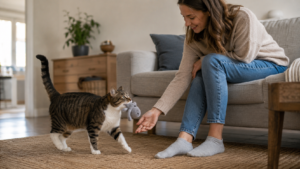
Cats do not understand ownership in the legal or human sense. However, they do recognize familiar individuals, scents, locations, routines, and social relationships.
When people jokingly say that a cat has “claimed” them, they are usually describing a collection of bonding behaviors.
Your cat has decided that:
That is the feline version of a deeply meaningful relationship.
Not every cat expresses affection in the same way. A confident cat may climb onto your chest, while a shy cat may demonstrate the same trust by sleeping quietly across the room.
Personality, age, health, socialization, and past experiences can all affect how openly a cat interacts.
The best way to strengthen your relationship is not to force affection. Give your cat choices, respect their boundaries, maintain a predictable routine, and allow them to approach you at their own pace.
Building trust does not require complicated training. Small, consistent actions usually matter most.
Spend a few minutes playing with your cat every day using toys they can chase and capture. Speak gently, provide comfortable hiding and resting spaces, and avoid grabbing or holding them when they are trying to leave.
You can also use slow blinks, reward calm approaches with attention, and learn which areas of their body they enjoy having touched.
Watch for signals that your cat has had enough. Tail flicking, skin twitching, flattened ears, sudden tension, or turning quickly toward your hand can mean the interaction should stop. Some cats become overstimulated during prolonged petting, even when they initially approached for attention.
Respecting these signals teaches your cat that they remain in control of their body and can safely interact with you.
A cat may regularly seek you out, follow you, sleep near you, rub against you, initiate play, or appear more relaxed when you enter the room. Look for a consistent pattern rather than relying on one behavior.
Your cat may be greeting you, leaving familiar scent, requesting brief attention, or simply acknowledging your presence. Walking away does not mean the interaction was negative.
Some cats enjoy companionship more than physical handling. Following you allows them to remain socially connected while keeping control over distance and touch.
Yes. A cat may form strong relationships with several household members while interacting differently with each person. One person may provide food, another may be the preferred play partner, and another may be the favorite sleeping companion.
A temporary increase in affection may follow stress, changes in routine, or a period when you were away. However, a sudden behavioral change accompanied by hiding, appetite changes, unusual vocalization, reduced activity, or other symptoms should be discussed with a veterinarian.
Cats rarely announce their love loudly. Instead, they communicate through small decisions repeated every day.
They watch you. They follow you. They press their forehead against your hand, slowly close their eyes, knead your blanket, and choose to sleep near you when the house becomes quiet.
Individually, these moments may appear ordinary. Together, they reveal something special.
Your cat has decided that you are familiar, trusted, and important.
So, when you notice these signs your cat has claimed you, remember that you have received one of the highest compliments a cat can offer: they have chosen to make you part of their world.