Physical Address
840 Oakwood Rd, Charleston, WV 25314
Physical Address
840 Oakwood Rd, Charleston, WV 25314

Rusty had learned that people rarely looked down.
Every day, hundreds of shoes passed in front of him at the crowded bus station. Shiny office shoes, dusty work boots, colorful children’s sandals, and hurried feet that never stopped long enough to notice the thin brown dog lying beneath the broken wooden bench.
Rusty had once worn a blue collar. A small silver tag had hung from it, but the writing had faded long ago. The collar was now loose around his neck because he had lost so much weight.
No one knew how long he had been living at the station.
Some people believed his owner had accidentally lost him. Others said they had seen a car stop near the station late one evening. The door opened, Rusty was pushed outside, and the car disappeared before he understood that it was never coming back.
Rusty waited beside the road for three days.
Every time a blue car appeared, he stood up quickly. His tired tail moved from side to side, and hope returned to his eyes.
But every car continued without stopping.
Eventually, Rusty walked beneath the bus station bench and made the cold concrete his home.
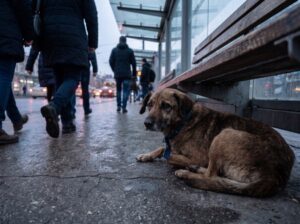
During the day, he searched the ground for fallen food. At night, he curled himself into a tight ball to stay warm. Loud buses frightened him, and strangers sometimes chased him away, but he always returned to the same bench.
It was the last place where he had seen the road his family had taken.
One rainy evening, Rusty heard a tiny sound beneath him.
“Mew.”
He lifted his head.
At first, he thought the sound had come from the rainwater running through the gutter.
“Mew.”
Rusty slowly stood and looked beneath the bench. Two round eyes stared back at him from behind an abandoned cardboard box.
A tiny gray kitten was hiding there.
She was soaked from the rain. Her fur was dirty and stuck closely to her thin body. One of her ears had a small tear, and she was shaking so badly that the box moved around her.
Rusty lowered his head and sniffed carefully.
The kitten hissed.
Rusty stepped back.
He understood fear. He understood what it meant to expect every approaching hand, foot, or animal to hurt you.
Instead of moving closer, Rusty lay down a short distance away. He placed his head between his paws and waited.
The kitten watched him for a long time.
Eventually, she crawled out of the box.
That night, the kitten slept against Rusty’s stomach. His body protected her from the wind, and her tiny heartbeat gave him something he had not felt since the blue car disappeared.
He was no longer completely alone.
Rusty called her Pebble—not with words, of course, but in the quiet way animals give names to those they love. She was small, gray, and always curled beside him like a smooth little stone.
From that evening forward, they became inseparable.
Rusty searched for food, and Pebble followed behind him. Pebble squeezed through narrow spaces to find shelter, and Rusty stood guard outside. When large dogs approached, Rusty placed himself between them and the kitten. When Rusty slept, Pebble climbed onto his back and cleaned the fur around his ears.
They had almost nothing, but everything they found was shared.
Across the street from the bus station, a woman named Mara operated a small food cart. She sold rice, grilled chicken, and hot soup to passengers.
Mara had noticed Rusty before, but he had always kept his distance. Whenever she approached, he lowered his body and moved away, as though he had learned that kindness could suddenly become cruelty.
One evening, Mara placed a small bowl of rice and chicken near the bench. Then she walked back to her cart.
Rusty waited until she was gone before approaching it.
He was starving. The smell of warm chicken filled his nose, and his stomach tightened painfully.
But Rusty did not begin eating.
He looked toward the cardboard box and gave a quiet whine.
Pebble appeared a moment later.
Rusty pushed the bowl toward her with his nose.
The kitten ate first.
Mara watched from across the road, covering her mouth with one hand. The abandoned dog was so hungry that his ribs were visible, but he waited patiently until the kitten had eaten enough.
Only then did Rusty finish what remained.
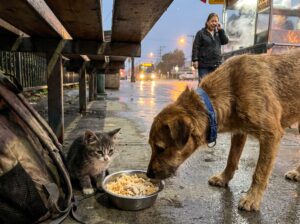
From that night onward, Mara brought them food every evening.
She always divided it into two small portions, but Rusty continued checking Pebble’s bowl before eating from his own. If her portion was smaller, he pushed some of his food toward her.
People at the station began to recognize the unusual pair.
Children stopped to watch Pebble climb over Rusty’s paws. Drivers left scraps of chicken near their bench. An elderly man brought them an old blanket, and Mara placed it inside a stronger box.
For a short time, the bus station felt almost like a home.
Then the storm came.
Dark clouds covered the sky early that afternoon. By evening, the wind was strong enough to shake the station signs. Rain poured across the road, filling the gutters and turning the ground into moving rivers.
Mara closed her cart earlier than usual.
Before leaving, she carried food to the bench. Rusty was there, but Pebble was missing.
“Where is your little friend?” Mara asked.
Rusty looked toward the road and whined.
Mara searched around the bench, behind the boxes, and beneath the parked buses. She called softly, but the storm swallowed her voice.
“Pebble!”
There was no answer.
Mara wanted to continue searching, but the rain was becoming dangerous. She placed the food under the bench and promised Rusty she would return at sunrise.
Rusty did not touch the bowl.
All night, he searched for Pebble.
He walked through flooded alleys, sniffed beneath vehicles, and pushed his head into narrow spaces where she might have hidden. Rain soaked his fur. Broken glass cut one of his paws, but he continued.
Whenever he heard a faint noise, he ran toward it.
Every time, he found only wind, water, or a piece of rubbish moving in the darkness.
By sunrise, Rusty returned to the bench alone.
Mara found him lying beside the untouched food. Mud covered his body, and blood stained the fur around his paw.
“Oh, Rusty,” she whispered.
She cleaned his injury and offered him fresh food, but Rusty turned his head away.
He stared at the empty cardboard box.
Pebble did not return that day.
She did not return the next day either.
Rusty began following the same routine every evening. When Mara brought his food, he ate exactly half. Then he pushed the bowl toward Pebble’s empty place beneath the bench.
He waited until the food became cold.
Only when the station grew quiet did he lie down beside it.
The next morning, the uneaten portion would still be there.
For seven nights, Rusty saved half his meal.
Passengers thought he was no longer hungry. Some believed he was simply a picky dog. But Mara understood.
Rusty was still sharing with Pebble.
He believed she might return hungry.
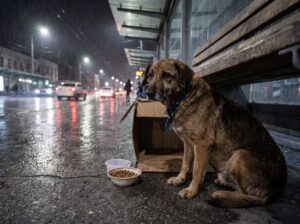
On the eighth evening, Mara sat beside Rusty.
The station was unusually quiet. A light rain tapped against the metal roof, and the last bus had already departed.
Rusty had placed half his food beside the box again.
“You miss her, don’t you?” Mara said.
Rusty lifted his head suddenly.
His ears moved forward.
Mara became silent.
At first, she heard nothing except the rain.
Then Rusty stood.
He walked away from the bench and stopped near a metal drain beside the station wall. He pressed his nose against it and whined.
Mara followed him.
“Is something there?”
Rusty scratched at the metal cover.
Mara knelt and listened.
A faint cry came from beneath the ground.
“Mew.”
Her heart began to pound.
“Pebble?”
The cry came again, weak but unmistakable.
During the storm, the kitten must have been swept into the drainage system. She had become trapped beneath the station, hidden behind mud, rubbish, and a damaged pipe.
Mara immediately called for help.
Two bus drivers brought tools. A nearby shop owner arrived with a flashlight. Together, they lifted the heavy drain cover and searched the dark tunnel below.
Rusty stood beside them, trembling.
One driver crawled carefully into the narrow space.
For several minutes, no one spoke.
Then his voice echoed from beneath the ground.
“I found her!”
He emerged holding a small bundle wrapped in his jacket.
Pebble was alive.
She was frighteningly thin, and her gray fur was covered with black mud. Her eyes were barely open. One paw appeared injured, but when she heard Rusty whining, her ears moved.
The driver placed her gently on the ground.
Rusty rushed forward but stopped before touching her. He sniffed her face, afraid she might disappear again.
Pebble opened her eyes.
She gave one weak meow and pressed her head against his nose.
Rusty began licking the mud from her fur.
Around them, grown men and women wiped tears from their faces.
Mara carried Pebble to the nearest animal clinic. Rusty followed the entire way, limping on his injured paw and refusing to let the carrier out of his sight.
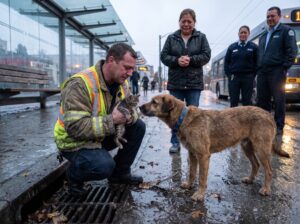
The veterinarian said Pebble was severely dehydrated and weak. Her paw was bruised, but fortunately, no bones were broken.
“She survived because she found a raised section inside the pipe,” the veterinarian explained. “She must have lived on small insects and rainwater.”
Rusty remained outside the treatment room.
Every time Pebble cried, he stood and scratched at the door.
Finally, the veterinarian allowed him inside.
Rusty lay beside Pebble’s cage. For the first time in eight nights, he ate an entire bowl of food.
Pebble recovered slowly.
As the days passed, Mara visited them at the clinic. She had spent years telling herself that her rented room was too small for a pet. She worked long hours, had very little money, and did not believe she could give an animal the perfect home.
But one afternoon, she saw Rusty sleeping beside Pebble’s cage, his nose resting between the metal bars.
Mara realized they did not need a perfect home.
They needed a safe one.
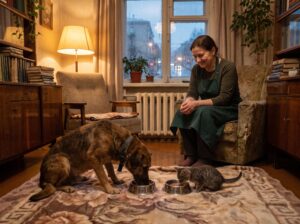
When Rusty and Pebble were healthy enough to leave the clinic, Mara brought them to her small room above the food cart.
There was only one window, one bed, and a tiny kitchen. Mara had placed a soft blanket in the corner and two bowls beside it.
Rusty walked slowly around the room. He sniffed the walls, the door, and the blanket.
Then he looked at Mara.
For a moment, his body remained still.
Perhaps he remembered another home. Perhaps he remembered a blue car, an open door, and the road where he had waited for someone who never returned.
Mara knelt in front of him.
“You don’t have to wait anymore,” she said.
Rusty stepped forward and placed his head against her chest.
Pebble climbed onto his back and began purring.
That evening, Mara served them two full bowls of food.
Rusty looked at Pebble’s bowl, as he always did. He waited until she began eating before touching his own meal.
But this time, he did not save half.
Pebble was beside him.
The rain started outside, tapping softly against the window. Rusty lifted his head at the sound, but there was no cold concrete beneath him, no flooded road to search, and no empty space beside the bench.
He was warm.
Pebble was safe.
And for the first time since the blue car drove away, Rusty understood that someone had finally come back for him.