Physical Address
840 Oakwood Rd, Charleston, WV 25314
Physical Address
840 Oakwood Rd, Charleston, WV 25314

One morning, you walk into the living room and find your two cats asleep on opposite ends of the couch.
They are not cuddling. They are not grooming each other. They barely seem aware that the other cat is there.
Are they friends, rivals, or simply roommates who have agreed to keep their distance?
Cats have a reputation for being independent animals. Unlike many dogs, they may not immediately welcome a new companion with excitement. Introductions can take days, weeks, or even months.
However, cats are capable of forming meaningful social bonds with one another.
Some become nearly inseparable. They sleep together, play together, exchange gentle grooming, and search for each other when separated. Others develop a quieter relationship based on trust, shared space, and peaceful coexistence.
So, do cats make friends with other cats?
Yes. Cats can form strong social relationships, although their friendships may look different from human or canine friendships. Whether two cats bond depends on their personalities, age, past experiences, socialization, territory, and how carefully they are introduced.
Domestic cats descended from animals that often hunted alone.
This helps explain why many cats value personal space and may defend important resources such as food, resting places, litter boxes, or access to their owners.
However, independence does not mean that cats are incapable of companionship.
Outdoor and free-roaming cats sometimes gather in social groups around reliable food sources. Within these groups, certain cats may spend more time together, groom one another, rest close by, or help care for kittens.
These connections are especially common among related females, mothers and offspring, or cats that grew up together.
Inside the home, cats can also form close relationships. Some bonds develop quickly, while others need a long period of peaceful exposure before trust appears. In certain cases, two cats may never become affectionate friends but can still learn to live together without conflict.

Cats do not usually choose companions based only on appearance, breed, or gender.
Compatibility often depends more on temperament and experience.
A playful young cat may enjoy another energetic companion. A quiet senior cat may feel overwhelmed by a kitten that constantly jumps, chases, and wrestles.
Cats may have an easier time bonding when they:
Littermates and kittens raised together often form close bonds because they learn social behavior during early development. However, unrelated adult cats can also become excellent companions when their personalities fit and their introduction is handled patiently.
Friendly cats often approach one another without stiffness or hesitation.
They may:
A raised tail during a greeting is often a positive social signal. Nose touching allows cats to exchange scent information while showing that they feel safe enough to approach closely.
The key is relaxation.
If one cat crouches, flattens their ears, lashes their tail, or tries to escape, the interaction is probably not friendly.
Sleeping leaves a cat vulnerable.
A cat that chooses to rest near another cat is demonstrating a degree of trust.
Bonded cats may:
Not all feline friends cuddle.
Some prefer to leave a small distance between them while still choosing the same room or resting area. This can also be a sign that they enjoy each other’s company.

Social grooming between cats is known as allogrooming.
One cat may lick the other cat’s head, ears, neck, or face—areas that can be difficult to groom alone.
Mutual grooming can help cats:
Occasionally, grooming may suddenly turn into gentle biting or wrestling. This does not always mean the friendship has ended. One cat may simply become overstimulated or decide that the grooming session has lasted long enough.
Friendly cats usually recover quickly and remain comfortable around each other.
Play between cats can look dramatic.
They may chase, jump, roll, bite, or wrestle. To a concerned owner, it can appear similar to fighting.
Friendly play is usually:
One cat may be on top during one moment and underneath during the next.
Real conflict tends to include growling, prolonged hissing, screaming, puffed fur, flattened ears, defensive postures, or one cat desperately trying to escape.
When one cat always chases and the other always hides, the interaction may not be equal play.
Cats have scent glands around their cheeks, forehead, chin, sides, and tail area.
When cats rub against each other, they exchange scent and create a shared group smell.
This behavior can be a strong sign of social acceptance.
You may see them:
Sharing scent helps the cats recognize each other as familiar and safe.
Friendship does not always look affectionate.
Sometimes, the clearest sign of a successful relationship is that two cats can simply relax in the same room.
They may eat several feet apart, watch birds from the same window, or play with separate toys without guarding the space.
Peaceful sharing means neither cat feels the need to:
Cats that calmly coexist may have a stable social relationship even if they rarely cuddle.

Bonded cats may notice when their companion is missing.
One cat may:
This may be especially noticeable after a veterinary visit.
The cat that stayed home may investigate the returning cat carefully because the clinic has changed their familiar scent.
A calm reintroduction may be needed if the returning cat smells unfamiliar and receives hissing at first.
Cats monitor potential threats closely.
A cat that sits with their back toward another cat is showing that they do not expect an attack.
This small behavior is easy to overlook.
Two cats facing different directions while sitting nearby may appear disconnected, but their relaxed posture can actually demonstrate strong trust.
They feel safe enough to stop watching each other.
Not every peaceful pair is deeply bonded.
Some cats develop a polite arrangement in which they avoid conflict but do not actively seek companionship.
They may:
This is not necessarily a problem.
Cats do not need to become best friends to live happily in the same household. A calm relationship with clear personal space can be a successful outcome.
The goal should be safety and low stress—not forced affection.
Some behaviors suggest that one or both cats feel threatened.
Watch for:
Conflict can be subtle.
One confident cat may control the home without frequent fights simply by staring, blocking pathways, or occupying important resources. The less confident cat may respond by hiding or changing their daily routine.
Sudden aggression can also be linked to pain, illness, fear, or a change in scent. A veterinary examination is advisable when behavior changes unexpectedly.
Many owners worry that a cat living alone must be lonely.
That is not always true.
Plenty of cats are completely content as the only feline in the home. They may receive companionship, play, affection, and enrichment from their human family without wanting to share their territory.
A second cat may be helpful when the resident cat:
However, bringing home another cat is not guaranteed to cure loneliness or boredom.
The resident cat may view the newcomer as competition rather than company. Catster notes that many cats are satisfied living without another cat, even though others can adjust to and eventually bond with a new companion.
Consider your cat’s personality, age, health, history, and available space before making the decision.
There is no fixed timetable.
Some kittens begin playing within days. Adult cats may need several weeks or months to feel comfortable. Catster notes that forming a close bond—or even reaching peaceful tolerance—can sometimes take six months or longer. Some pairs may never become affectionate friends.
Progress is rarely perfectly smooth.
You may see:
Do not judge the entire relationship based on one difficult moment.
Look for changes over time.
Do not place a new cat directly in front of the resident cat and expect an immediate friendship.
Start with separate spaces.
Allow them to become familiar through:
Slow introductions reduce fear and territorial pressure.
Competition creates tension.
In a multi-cat household, provide multiple:
A widely used guideline is one litter box per cat, plus one additional box, distributed in separate accessible locations.
Resources placed together may still feel like one guarded area, so spread them throughout the home.
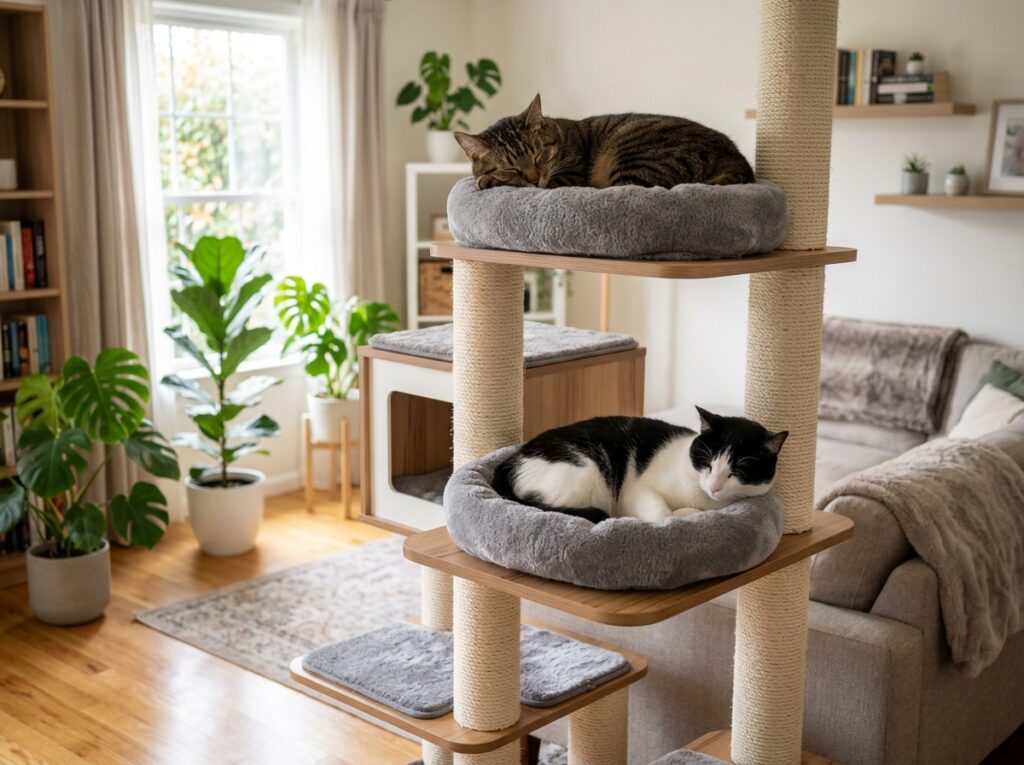
Cats often avoid conflict by moving to different heights.
Cat trees, shelves, window perches, and sturdy furniture allow each cat to choose a comfortable location.
Vertical territory is especially valuable in smaller homes because it increases usable space without requiring a larger floor area.
Offer treats, gentle praise, or play when the cats are relaxed near one another.
This helps each cat associate the other’s presence with positive experiences.
Do not punish hissing.
Hissing is communication. It usually means a cat feels uncomfortable and wants more distance. Punishment may increase fear and make the other cat’s presence feel even more negative.
Avoid holding one cat near the other, placing them in the same small carrier, or pushing them together for photographs.
Friendship must develop voluntarily.
Give both cats ways to leave an interaction. Cats often feel calmer when they know escape is possible.
Some cats will never cuddle, groom each other, or play together.
That does not automatically mean the household has failed.
If both cats can:
Then peaceful coexistence may be enough.
However, seek help from a veterinarian or qualified feline behavior professional if one cat is being injured, chronically intimidated, prevented from accessing resources, or showing ongoing stress.
Catster advises seeking veterinary guidance when cats struggle to adjust to one another or when introductions are not progressing safely.
Cats can recognize familiar companions through scent, voice, appearance, and shared routines. Bonded cats may seek each other out, sleep nearby, groom each other, or show distress when separated.
Some cats benefit greatly from feline companionship, especially compatible kittens or cats that have lived socially before. Others prefer being the only cat. Happiness depends more on personality and compatibility than the number of cats in the home.
Yes. Adult cats can form close bonds, but introductions often take longer than they do with kittens. Patience and gradual exposure are important.
Bonded cats may search, call, sleep more, eat less, or change their routine when a companion disappears. Any ongoing loss of appetite or major behavior change should be discussed with a veterinarian.
Brief hissing can be normal because it communicates discomfort and a need for distance. Repeated attacks, resource guarding, or intense fear indicate that the introduction should be slowed down.
Yes. Cats may show friendship by sharing rooms, greeting calmly, playing, resting nearby, or turning their backs on each other. Not every bonded pair enjoys physical contact.
Cats may be independent, but they are not incapable of friendship.
They can form close social bonds with littermates, unrelated cats, and new companions introduced later in life. These relationships may include grooming, play, shared sleep, nose touching, scent rubbing, and quiet companionship.
Still, every cat is different.
Some want a constant companion. Others prefer personal space. Many fall somewhere in between, enjoying another cat’s presence while maintaining their own routines.
So, do cats make friends with other cats?
Absolutely—but friendship cannot be forced.
Give them time, enough resources, gradual introductions, and the freedom to choose how close they want to become.
One day, you may find them curled together in the same bed. Or you may notice something much quieter: two cats sitting side by side, calmly watching the world through the same window.
Either moment can be a beautiful sign of trust.