Physical Address
840 Oakwood Rd, Charleston, WV 25314
Physical Address
840 Oakwood Rd, Charleston, WV 25314

You call your cat’s name from across the room.
Their ears turn toward you. Their eyes open slightly. For one hopeful second, you believe they are about to come running.
Then they close their eyes and return to sleep.
Moments like this can make cats seem impossible to train. Dogs often appear eager to follow instructions, while cats prefer to decide whether an activity is worth their time.
However, cats are intelligent animals capable of learning routines, cues, tricks, and useful household behaviors. They can learn to come when called, sit, give a paw, enter a carrier, use a scratching post, and walk in a harness.
So, can cats be trained like dogs?
Yes—but successful cat training usually requires a different approach. Rather than expecting obedience for its own sake, you need to discover what motivates your cat and make each lesson rewarding. Cats also tend to benefit from brief sessions that match their shorter periods of focused attention.
Dogs have lived and worked closely with humans for thousands of years, often performing tasks that required cooperation and attention to human direction.
Cats developed a different relationship with people. They are typically more independent and may not naturally look to their owners for instructions in the same way many dogs do.
That does not mean cats are stubborn or unintelligent.
A cat may simply ask a different question.
A dog might think, “What does my owner want me to do?”
A cat is more likely to think, “What will happen if I do it?”
Food, play, attention, access to a favorite place, or the opportunity to chase something can all become valuable rewards.
Cats may also show focus more subtly than dogs. A dog may stare, wag, or become visibly excited. A cat might only turn their ears, shift their body, or look briefly at your hand.
Learning to recognize these small signals can make training much easier.

Cats can learn far more than many owners expect.
Depending on personality, confidence, health, and motivation, your cat may learn to:
Catster notes that cats may learn behaviors such as sitting, offering a paw, walking on a leash, going to a particular place, jumping through objects, rolling over, finding items, and responding to recall cues.
Not every cat will enjoy every trick. One cat may love learning to fetch but dislike wearing a harness. Another may master a high-five yet refuse to sit on command.
Training should suit the individual cat rather than becoming a competition with dogs or other pets.
Food is a powerful reward for many cats, but it is not the only option.
Your cat may work for:
Use small rewards so your cat does not become full too quickly.
Treats should remain a limited part of your cat’s overall diet. Catster recommends using low-calorie rewards or pieces from the cat’s regular food allocation rather than offering excessive extras.
A long training session may work for an energetic dog, but many cats lose interest quickly.
Begin with sessions lasting approximately one to three minutes. Stop while your cat is still engaged rather than waiting until they walk away.
You can practice several times throughout the day:
Several short, successful sessions are usually more effective than one long and frustrating lesson.
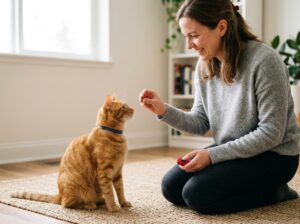
Timing matters.
Your cat needs to understand which action earned the reward. Deliver the treat immediately after the desired behavior.
A clicker can make this clearer.
The click becomes a marker that says, “That exact action was correct.”
To introduce a clicker:
A short word such as “yes” can also work when used consistently.
Training becomes easier when you start with something your cat already likes doing.
For example:
Catster similarly recommends building early lessons around behaviors the cat already performs naturally.
Early success keeps both you and your cat interested.
Your cat is not refusing to annoy you.
They may be confused, distracted, tired, nervous, or simply insufficiently motivated.
Do not:
Punishment can make a cat fearful of you, the training location, or the behavior itself. Catster specifically advises against punishment and emphasizes patience when cats do not respond immediately.
When your cat makes a mistake, pause and make the next step easier.
Many owners repeat “sit” before the cat understands what the word means.
Instead, first guide the behavior.
For teaching “sit”:
The word gains meaning by being repeatedly connected to the action.
Do not continue until your cat becomes bored or irritated.
Finish after one good attempt, even if the lesson lasted only thirty seconds.
Give a reward, offer praise, and allow your cat to leave.
Ending positively makes the next session easier because your cat remembers training as a rewarding activity rather than an obligation.

Recall is one of the most useful skills a cat can learn.
Start from a short distance.
Say your cat’s name followed by a consistent cue such as “come.” Show or shake the reward if necessary. When your cat approaches, mark the behavior and reward generously.
Gradually increase the distance and practice from different rooms.
Never call your cat only for unpleasant experiences such as medication, bathing, or leaving the house.
Hold a treat slightly above your cat’s nose and slowly move it backward.
Many cats naturally sit as they lift their head to follow the treat.
The moment their bottom touches the floor, mark and reward.
Avoid pressing down on your cat’s back.
Place a treat inside your closed hand and hold it near your cat.
Your cat may sniff, lick, or paw at your hand. When they touch it with a paw, mark and reward.
After several repetitions, present an open palm and gradually add the cue “high-five.”

Some cats can learn to enjoy harness walks, but the process must be gradual.
Begin indoors:
Never use a collar alone for walking a cat. A properly fitted harness is safer because frightened cats can easily slip from loose equipment.
Not every cat enjoys outdoor walks. Some prefer watching the world through a secure window or enclosed patio. Respect your cat’s body language and never force them into an environment that causes fear.
Kittens often learn quickly because they are curious and still developing routines, but adult and senior cats can also learn.
An older cat may need:
Training can provide mental stimulation and strengthen your relationship at any age.
However, reluctance to sit, jump, walk, or offer a paw may indicate pain or reduced mobility. Speak with a veterinarian when your cat suddenly stops performing an action they previously enjoyed.
Break every trick into very small steps. Reward progress rather than waiting for perfect performance.
A treat that one cat loves may be ignored by another. Experiment safely until you find the strongest motivator.
Begin somewhere quiet, away from other pets, loud televisions, or busy windows.
Saying “sit, sit, sit” teaches your cat that the first word does not matter. Say the cue once, wait briefly, and reset if needed.
Your cat does not need to perform with the same speed or enthusiasm as a dog. Progress may be quieter but still meaningful.
Cats are not necessarily less intelligent, but many are less motivated by human approval and may focus for shorter periods. Training tends to work best when sessions are brief and strongly rewarding.
Hand targeting, sitting, and coming when called are often good starting points because they build on natural movements.
Cats can learn that a particular sound predicts attention, food, play, or another outcome. Pairing the name with positive experiences can improve their response.
Some cats understand a simple behavior within a few sessions, while others need several days or weeks. Progress depends on the cat, the skill, the reward, and the trainer’s consistency.
Many cats are more motivated shortly before a normal meal. Use tiny rewards and include them within the cat’s daily food allowance.
It is usually easier to begin separately so each cat can focus and receive rewards clearly. Group training may become possible after both cats understand the behavior.
Cats may not respond exactly like dogs, but that does not make them untrainable.
They simply learn best when the lesson feels worthwhile.
Short sessions, immediate rewards, gentle repetition, and realistic expectations can teach your cat useful behaviors and entertaining tricks. Training can also make carrier use, grooming, veterinary visits, and daily communication less stressful.
So, can cats be trained like dogs?
They can learn many of the same skills—but the experience works best when you train the cat in front of you rather than expecting them to behave like a dog.
Respect their choices, celebrate small progress, and keep every session positive.
Your cat may never obey every request. But one day, when they run toward you after hearing “come” or proudly place a paw against your hand, you may realize they were capable of learning all along.